


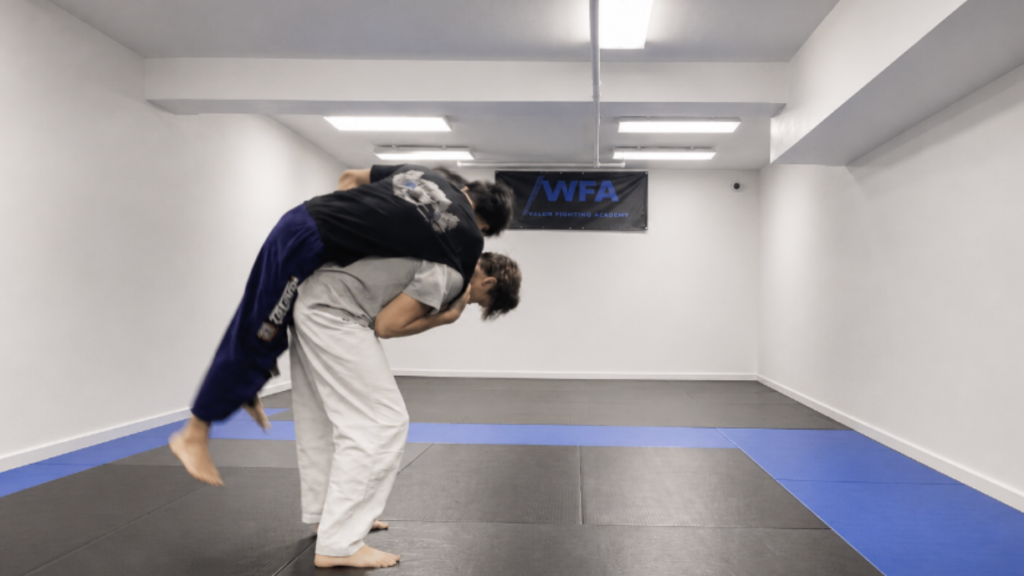
Why Focus on the Standing Game
When people think of Brazilian Jiu-Jitsu, they often picture the ground: sweeps, submissions, positional battles fought inches from the mat. But every fight starts standing, and how you get your opponent to the ground matters more than most people realize. That’s why, here at Northwest Fighting Arts, we spend serious time developing our takedown game, and one throw sits at the top of our list: the arm throw, known in judo as Seoi Nage.
https://www.instagram.com/p/DZF-fR2uDDd/
What Is an Arm Throw?
The arm throw is a hip-load takedown where you break your opponent’s balance forward, step underneath them, load their weight onto your back and hips, and drive them to the mat with a powerful rotation. It’s one of the most fundamental throws in both judo and wrestling, and it translates beautifully into BJJ, whether you’re competing in a gi or no-gi.
There are a few common variations:
- Two-handed (Ippon Seoi Nage): You trap one of their arms at the elbow, load them over your shoulder, and throw.
- One-arm/drop version: A lower-stance variation where you drop to your knee, great for wrestlers who prefer a level-change entry.
- No-gi arm drag entry: Using an arm drag to expose the back and transition into a hip throw finish.
Why We Love This Throw
1. It Works at Every Level
Whether you’ve been training for three months or ten years, the arm throw has something to offer you. Beginners can drill the entry and the hip load as fundamental movement patterns. Advanced grapplers can chain it with feints, off-balance setups, and combination attacks that create openings even against experienced opponents.
2. It Sets Up the Ground Game Perfectly
One of the biggest advantages of the arm throw in BJJ specifically is where it puts you when it lands. A well-executed throw puts you in a dominant position, often with back control or a direct path to side control, before your opponent has time to react. You’re not just taking them down; you’re already ahead on the ground.
3. It Teaches Core BJJ Principles
The mechanics of a good arm throw reinforce some of the most important concepts in all of grappling:
- Kuzushi (off-balancing): You can’t throw someone who’s balanced. Breaking posture first is everything.
- Timing over strength: A throw that’s forced rarely works. The arm throw teaches you to feel for the right moment.
- Hip connection: Your power doesn’t come from your arms. It comes from your hips and legs, the same engine that drives sweeps and guard passes on the ground.
4. It’s Adaptable
Tall? There’s a variation for you. Shorter and stocky? There’s a variation for you too. The arm throw family of techniques is one of the most adaptable in grappling, which is part of why it has survived and thrived across judo, sambo, wrestling, and BJJ for well over a century.
Breaking Down the Basic Entry
Here’s a simplified look at the key steps:
- Establish your grip: In the gi, collar and sleeve. No-gi, underhook or wrist control.
- Break their balance forward: Pull them onto their toes. They should feel like they’re about to fall.
- Step across and turn in: Your foot plants between theirs, your back turns into their chest.
- Load the hip: Bend your knees, get your hips below their center of gravity.
- Extend and rotate: Stand up through your legs while pulling their arm down and across. Let your hips do the work.
- Follow to the mat: Don’t stop at the throw. Stay connected and establish your position.
Two Ways to Learn It: Beginner and Advanced
Beginner Version: Drop Knee Seoi Nage
If you’re newer to throwing, the drop knee version is the perfect place to start. Instead of trying to load your opponent while staying on your feet, you drop to one or both knees as you turn in. This lowers your center of gravity significantly, making it much easier to get your hips underneath them without needing a lot of hip flexibility or timing.
Here’s what it looks like: as you turn in, you trap their arm over your shoulder and drop to your knees while pulling them forward. Their weight naturally falls over you, and you finish the throw by rotating and pulling their arm down to the mat. It’s forgiving on the entry, easy to drill, and still delivers a clean, controlled takedown. Many competitors use this version their entire career. It’s not just a stepping stone; it’s a legitimate technique in its own right.
Advanced Version: Standing Seoi Nage
Once you’re comfortable with the movement pattern, the standing version is where the throw really opens up. Rather than dropping to your knees, you stay on your feet throughout the entire throw, loading your opponent onto your hips and back while upright, then driving through with leg extension and hip rotation to send them over.
The standing version requires better timing, sharper kuzushi (off-balancing), and more hip mobility, but the payoff is significant. It’s faster, harder to defend, and transitions more seamlessly into follow-up attacks if the throw doesn’t finish cleanly. It also gives you better positioning on the landing since you remain on your feet and can choose where and how you follow to the mat.
The path most grapplers take: drill the drop knee version until the entry feels automatic, then gradually work toward staying on your feet. The muscle memory carries over, and you’re just removing the safety net.
Common Mistakes to Avoid
- Standing too tall during the entry: If your hips are high, you’ll push instead of throw.
- Pulling with your arms instead of rotating your body: The arms guide; the hips throw.
- Telegraphing the setup: The best throws come off of reactions. Set it up with a push, a feint, or after they resist.
- Letting go at the end: In BJJ, the throw is just the beginning. Maintain your grip and land with a purpose.
Come Feel It for Yourself
Reading about a throw is one thing. Feeling the hip load, the rotation, the moment it all clicks, that’s something else entirely. At Northwest Fighting Arts, we build takedowns into our curriculum because we believe in complete grapplers.
Whether you’re stepping on the mat for the first time or looking to sharpen a competition game, our doors are open. Come drill it, break it down, and make the arm throw your own.